
The Radical Faeries
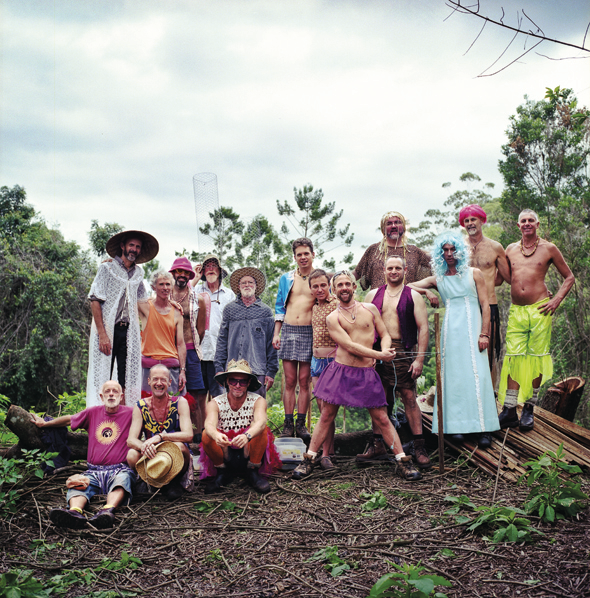
Here’s an overview of the Radical Faeries from radfae.org:
Who are the Radical Faeries?
Nobody speaks for Radical Faeries as a whole; certainly not us!
Generally, we tend to be queer people who look for a spiritual dimension to our sexuality; many of us are healers of one kind or another.
Our shared values include individual responsibility rather than hierarchy, gender fluidity, feminism, respect for the Earth. Many of us are pagan or follow a nature-based religion.
Our defining events are Faerie Gatherings, where we get together for an extended retreat, usually in the woods, separated from the outside world. A lot of that time is spent in “heart circles,” where we open up emotionally.
Of course, that’s just this circle’s attempt at a definition.
A bit about the founding of the Radical Faeries from Radical Faeries: SF’s Fabulously Weird Progressive Queers:
In the ’70s, founder Harry Hay was the first person in the U.S. to recognize homosexuals as an oppressed cultural minority, and the first to promote being gay as a social identity. At the time, many gays thought that in order to gain acceptance, they should imitate heterosexuals. Harry founded the Radical Faeries in 1979 as a way for gays to reject society’s norms. The Radical Faeries spread their message through artistic and ritualistic gatherings and festivals, first all over the United States, and then around the world.
This article describes one reporter’s experience at a BC Radical Faerie Camp:
Radical Faerie Camp
A magical weekend of warmth
I went to BC Radical Faerie Camp as a reporter seeking to capture Faerie culture, but Faerie culture captured me.
Influenced by pagan, Wiccan and native principles of valuing everyone, the loosely knit group accepts all queer men: old, young, skinny, chubby, tall, short, hairy, smooth, goth and geek, HIV-positive and -negative. Offering hard-to-find acceptance during the AIDS crisis, the Faeries flourished.
At camp, the thawing begins immediately. Strangers are more likely to give a big hug than a firm handshake. There should be a welcoming sign: “Dorothy, we’re not in Vancouver anymore.”
Throughout the weekend, 20-something Royce Edwardsen stands in front of the mirror, going through changes of gender-fuck drag (drag with body hair and genital bulges). Shawl? No shawl? Shawl? No shawl? Finally, his friend Scott Koza says, “Good lord, save some of that mirror for the rest of the weekend.”
Faeries wear drag to amuse others, bend gender stereotypes and celebrate their feminine side. At meals, Faeries in especially vibrant outfits walk down the aisle as everyone bangs utensils against glasses. At some point, each person is the centre of attention, whether walking down the aisle or exposing their vulnerable selves.
At Faerie 101, Robin Hood (Robert Birch) tells the group that in 1979, Harry Hay, a leader in the early gay movement and Faerie co-founder, wanted to create a world where gay men would be safe.
“His great question was ‘What else can “gay” be?’” Robin Hood says, reminding us not to leave anyone out.
“We’ve all been ‘othered,’” he says. “This is a chance to thaw out, where we’re all safe to be free and have fun.”
Want to learn more? Radfae.org has a wealth of resources about Faerie History, Archives, and Arts:
General
FaeNet.org: social network by and for faeries
GRFN.net: Global Radical Faerie Newsletter
Faerie History and Archives
Harry & John: A History
The Faerie Hymnal: chants and songs
The Faggots & Their Friends Between Revolutions, a 1977 book by Larry Mitchell and Ned Asta
ADD PDF Read Her: Faerie Finishing School A large collection of articles about faeries from Comfort and Joy (110MB PDF download)
The Secret History of the Radical Faeries, an alternative view by Douglas Sadownick
A Spiritual Conference for Radical Faeries 1979: The Call to the first gathering
The Faeries Gather, a poster for the audio recording of faerie history, from the 1980 Colorado gathering
A Leaf In the Wind, an autobiographical perspective on Seattle’s Gay Movement in the 1970’s
Hope Along The Wind, a documentary film about the life of Harry Hay
The Fire in Moonlight, a radical faerie anthology edited by Mark Thompson. Nearly fifty faerie stories from around the world, a glossary of faerie terminology and a resource guide.
Erogeny, a film by James Broughton
The Cockettes, a documentary of the legendary San Francisco theatrical troupe
Faerie Tales, a lovely documentary by Philip Roques from the 1990s.
The Feminine Boy Project by Cynthya BrianKate
Gay Wisdom for Daily Living, your daily dose of history
Faerie ARTS
Spirit Dancing, Radical Faerie Ritual Chants audio available for free download
RFD Magazine: a quarterly magazine produced by radical faeries since 1974
Radical Faerie Sanctuaries, a video
Camp Destiny builds a timber frame woodshed (video)
Strangelfreak’s compilation from 10 years in Lalaland, Barcelona
Lake Ivan Performance Group, improvisation and experimental video
