
May Day
Beltane, May Day, The Fires of Edinburgh, and the Coming of Summer
The old Celtic name for May Day is Beltane (in its most popular Anglicized form), which is derived from the Irish Gaelic 'Bealtaine' or the Scottish Gaelic 'Bealtuinn' (pronounced: beel-too-win), meaning 'Bel-fire', the fire of the Celtic god of light (Bel, Beli or Belinus).
Traditionally, Beltane festivities began days before May 1st or "May Day," when villagers traveled into the woods to gather the nine sacred woods needed to build the Beltane bonfires. According to the 13th century Irish poem called, "Song of the Forest Trees" the nine sacred woods are: Rowan - the wizard's tree; Briar - burn him that is so keen and green; Oak - fiercest heat giver of all timber; Alder - very battle-witch of all woods; Holly - burn it green, burn it dry; Elder - him that furnishes horses to the armies of the Sidhe burn; Birch - burn up most sure the stalks that bear the constant pads; Aspen - burn, be it late or early; and the Yew which is singled out as being sacred to the feast.
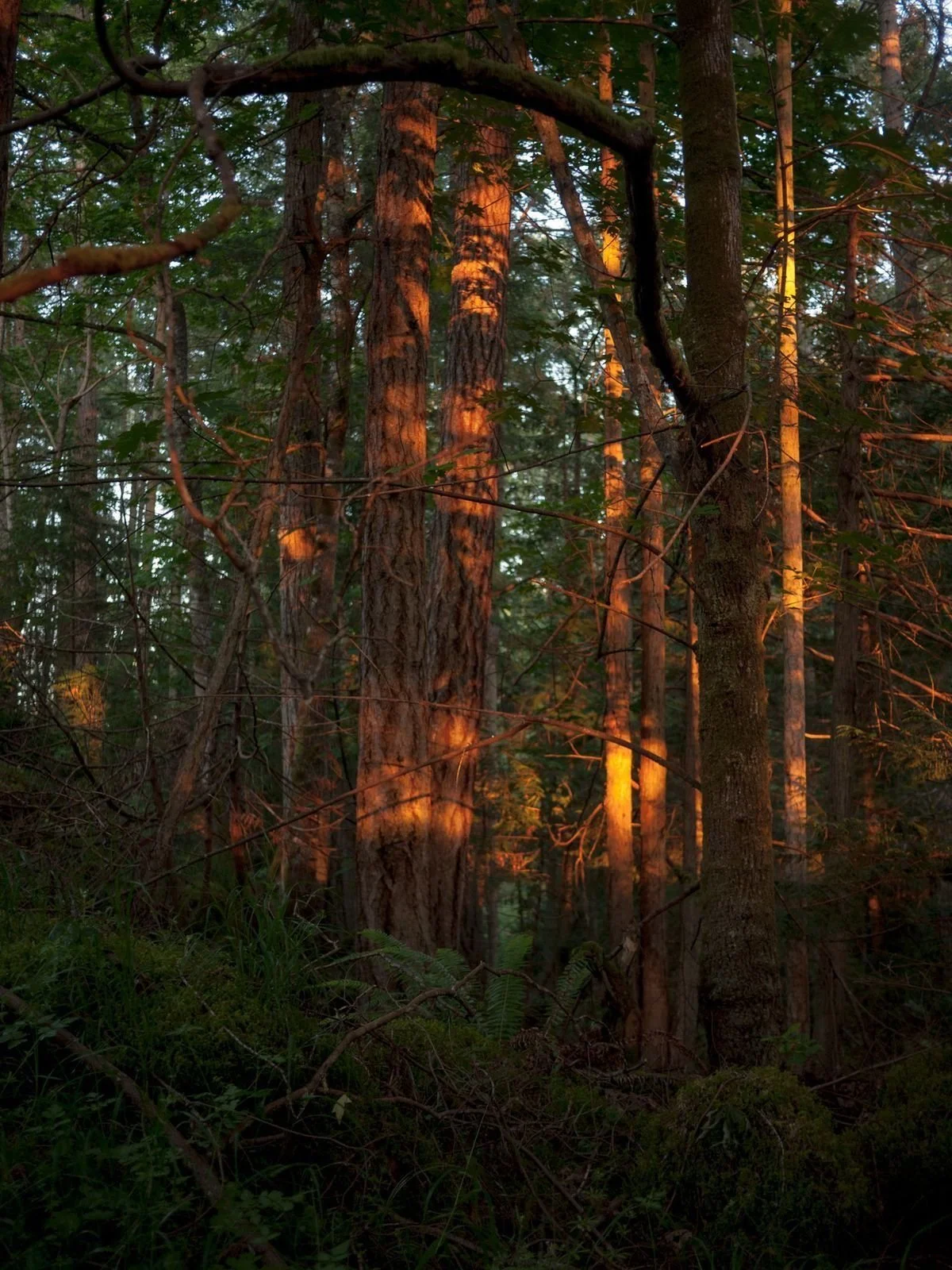
Sneaking off into the Woods
The Relaxing of Social Standards
Because the Celtic day started and ended at sundown, the Beltane celebration would begin at sundown on April 30th. After extinguishing all hearth fires in the village, two Beltane fires were lit on hilltops. The villagers would drive their livestock between the fires three times, to cleanse them and insure their fertility in the coming summer, and then put them to summer pasture. Then the human part of the fertility ritual would begin.
As dancing around the bonfires continued through the night, customary standards of social behavior were relaxed. It was expected that young couples would sneak off into the woods or, better yet, a recently plowed field for a little testing of the fertility waters. Even after handfasting was replaced by the Christian tradition of monogamous marriage, the Beltane ritual continued with a new tradition: all marriage vows were temporarily suspended for the festival of Beltane. Many a priest would lament the number of virgins despoiled on this one night, but the tradition persevered. Babies born from a Beltane union were thought to be blessed by the Goddess herself.
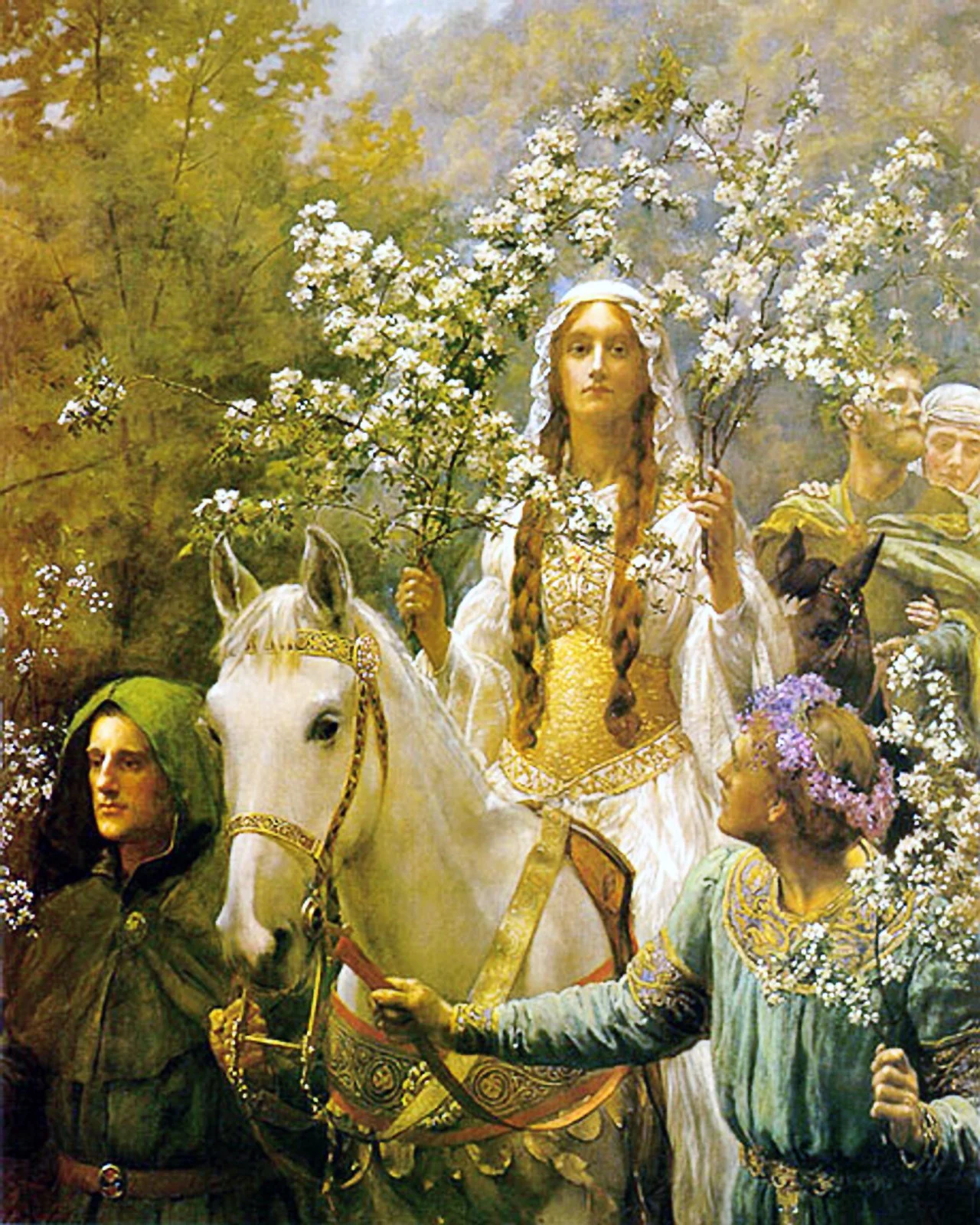
Ride of the
Fairy Queen
Beltane, like Samhain (Halloween), is a time when the veil between the worlds is thought to be thin, a time when magic is possible. Whereas Samhain revelers must look out for wandering souls of the dead, Beltane merrymakers must watch for Fairies. Beltane is the night when the queen of the fairies will ride out on her white steed to entice humans away to Faeryland. If you hear the bells of the Fairy Queen's horse, you are advised to look away, so she will pass you by; look at the Queen and your sense alone will not hold you back! Bannocks were also sometimes left for the Fairies, in hopes of winning their favor on this night.
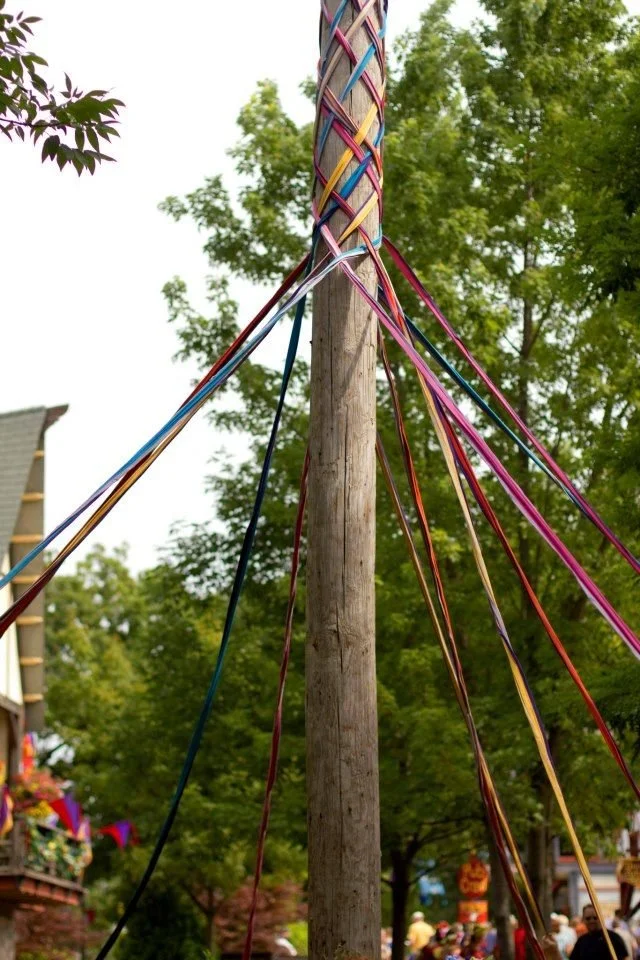
The Maypole
Beltane has recently seen a revival in Scotland. The Beltane Fire Society's Festival is held every year during the night of April 30th on Calton Hill in Edinburgh. An audience of around 15,000 people come to share the spectacular two-hour procession. Justifiably famous for its intensity and color, the event has become a much-loved feature of the Edinburgh calendar since it was first organised in the mid 1980s. A May Queen and Green Man, representing fertility and growth, cavort on the hillside with much merry-making. The main element is still fire, and whilst for some it will embody a "religion" that still resonates today, for many it represents a good spectacle and a fun night out.
Dancing a maypole is the most traditional way of celebrating May Day. Go to your local hardware store and buy a 20-foot wooden pole (most rural folk can cut it themselves). Ask your guests to bring their own ribbons, 20 feet in length and about two inches wide, in any color and be sure to have several extras on hand anyway. At the party, tie all the ribbons to the top of the pole (you may want to buy an eye hook to make this easier) and plant the other end of the pole several feet into the ground. Have everyone form a circle, and count off in twos; have the "ones" face clockwise and the "twos" face counterclockwise. Have everyone grasp their partner's right hand, then pass them by on the right. Now, grasp left hands and pass by on the left. Then right, then left, and so on. Once you've made it once around the circle, pick up your ribbons and begin again, this time weaving your ribbons as you go.
Other Beltane Traditions
May Birching
The tradition of "May Boughing" or "May Birching" involved young men fastening garlands of greens and flowers on the windows and doors of their prospective ladyloves before the fires are lit Beltane night. As with many Celtic customs, the type of flowers or branches used carried symbolic meaning, and much negotiating and courting could be worked out ahead of time.
May Queen & King
Many communities elected a virgin as their "May Queen" to lead marches or songs. To the Celts, she represented the virgin goddess on the eve of her transition from Maiden to Mother. Depending on the time and place, the consort might be named "Jack-in-the-Green", or "Green Man," or "May Groom", or "May King." The union of the Queen and her consort symbolized the fertility and rebirth of the world.
Beltane Fool
A big Beltane Bannock (or cake) was made and shared amongst the group. This is a special cake made of eggs, milk and oatmeal. For Beltane this bread was made the eve before Beltane day, it is said that the bread should not allow it to come into contact with steel during preparation (steel is harmful, deadly to the faery folk). These cakes also served magical and ritual purposes: They were marked for baking with nine raised nipples or nine squares, or with nine scalloped edges. One each for the nine sacred woods used in the needfire. Pieces of the bannock were thrown into the fire with an exhortation to bless homes, cattle or individuals. Well into the 20th century it was common, in the places where the fires were still lit, to have one piece of the cake blackened with charcoal. That piece was distributed from a hat along with the other pieces. Whoever drew this piece out of the hat had to leap three times through the flames. This custom is thought to have originated in the late Bronze Age. By this time the practice of having a designated Beltane Carline ("scapegoat" or "Fool" ) – or the sacrificial offering - had evolved. It was believed that any misfortune would fall on the Fool, sparing the rest of the people. It is now generally believed to be a myth that the Fool was ever burned as a human sacrifice; this seems to have stemmed from Christian priests and their attempts to condemn Beltane festivities. Later customs called for the Fool to leap three times through the Beltane fire, and according to earlier customs the Fool was banned from all Beltane activity. In all the recorded histories of the Beltane fire the "sacrifice" was never carried out.
